
State-of-the-Art Performance
The BioAgents analysis agent achieves state-of-the-art performance on the BixBench benchmark, outperforming all existing solutions: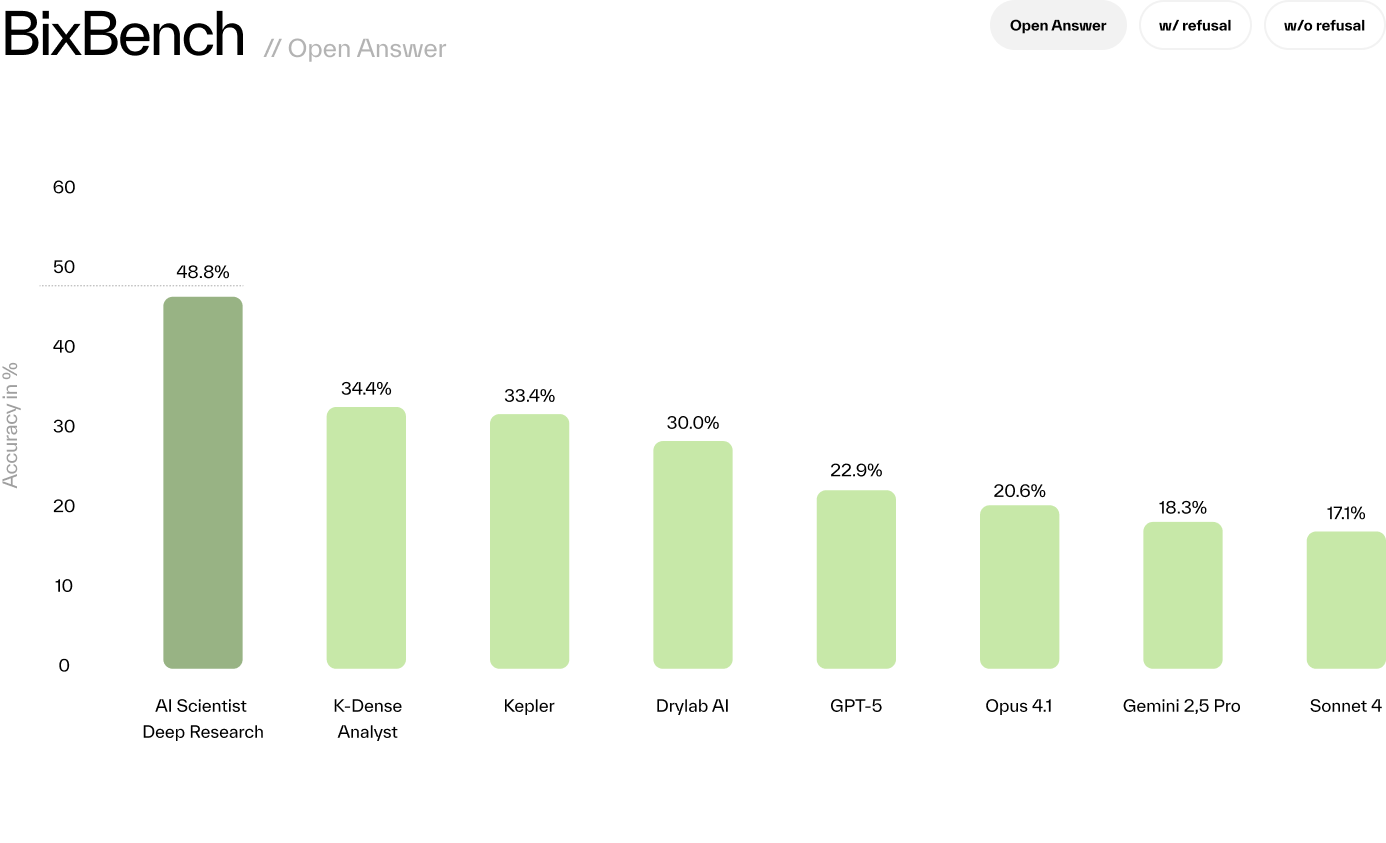
| Evaluation Mode | Score |
|---|---|
| Open-Answer | 48.78% |
| Multiple-Choice (with refusal) | 55.12% |
| Multiple-Choice (without refusal) | 64.39% |
Learn more:
- Introducing BioAgents - Detailed blog post about our literature and analysis agents
- Scientific Paper (arXiv) - Full technical details and methodology
Key Features
Configurable Research Agents
BioAgents allows you to choose your primary literature and analysis agents. While multiple backends are supported, BIO is the recommended default:| Agent Type | Primary (BIO) | Alternative |
|---|---|---|
| Literature | BioAgents Literature API - semantic search with LLM reranking | OpenScholar, Edison |
| Analysis | BioAgents Data Analysis - state-of-the-art benchmark performance | Edison |
Agent Architecture
BioAgents operates through two main modes: Chat Mode - Agent-based chat for general research questions with automatic literature search Deep Research Mode - Iterative hypothesis-driven investigation with:- Automatic research planning
- Literature search and synthesis
- Data analysis on uploaded datasets
- Hypothesis generation and refinement
- Research reflection and discovery tracking
Available Agents
File Upload Agent
Handles file parsing, storage, and automatic description generation. Supports PDF, Excel, CSV, MD, JSON, and TXT files.
Planning Agent
Creates research plans based on user questions, analyzes available datasets, and generates task sequences.
Literature Agent
Searches and synthesizes scientific literature from multiple sources including OpenScholar, Edison, and custom knowledge bases.
Analysis Agent
Performs data analysis on uploaded datasets using Edison or BioAgents Data Analysis Agent backends.
Hypothesis Agent
Generates testable hypotheses by synthesizing findings from literature and analysis with inline citations.
Reflection Agent
Extracts key insights and discoveries, updates research methodology, and maintains conversation-level understanding.
Technical Capabilities
Multi-Provider LLM Support
The LLM library provides a unified interface for multiple providers:- Anthropic (Claude models with extended thinking support)
- OpenAI (GPT-4 and later models)
- Google (Gemini models)
- OpenRouter (access to various models)
Vector Database & Knowledge Base
Built-in vector database with:- Semantic search using pgvector
- Cohere reranker for improved results
- Document processing from local
docs/directory - Support for PDF, Markdown, DOCX, and TXT formats
Production-Ready Features
Authentication
Support for JWT authentication and x402 USDC micropayments for pay-per-request access.
Job Queue
BullMQ integration for horizontal scaling, job persistence, and automatic retries with Bull Board dashboard.
File Storage
S3-compatible storage integration for dataset uploads and analysis artifacts.
WebSocket Support
Real-time notifications for job progress and status updates.
Tech Stack
BioAgents is built with modern technologies:- Runtime: Bun - A fast all-in-one JavaScript runtime
- Web Framework: Elysia - High-performance web framework
- Database: Supabase (PostgreSQL) with pgvector extension
- Frontend: Preact - Lightweight React alternative
- Job Queue: BullMQ with Redis (optional)
- Payment Protocol: x402 with Coinbase embedded wallets
BioAgents is designed to be modular and extensible. You can start with the basic setup and add advanced features like job queues, payment protocols, and custom analysis backends as your needs grow.
Next Steps
Quickstart
Get up and running in minutes with the essential setup guide
Setup Guide
Complete configuration guide for all features and integrations