
Design Philosophy
NetBird’s architecture is built on several core principles:Zero Configuration
Peers automatically discover each other and establish connections without manual configuration of ports, firewall rules, or VPN gateways. The system handles:- Automatic IP address assignment
- Peer discovery through the management service
- NAT traversal using STUN/TURN servers
- Dynamic network topology updates
Peer-to-Peer First
Direct peer-to-peer connections are always preferred over relay connections for optimal performance:- WebRTC ICE is used to discover connection candidates and establish direct paths
- STUN servers help peers discover their public endpoints
- Relay servers (TURN) are used only when direct connection fails
- WireGuard provides the actual encrypted tunnel once a path is established
Centralized Control, Distributed Data
While the Management Service maintains network state and access policies, actual data flows directly between peers:- Management Service: Centralized control plane for authentication, authorization, and network configuration
- Signal Service: Facilitates WebRTC signaling for peer connection negotiation
- Data Plane: Fully distributed peer-to-peer WireGuard tunnels
High-Level Architecture
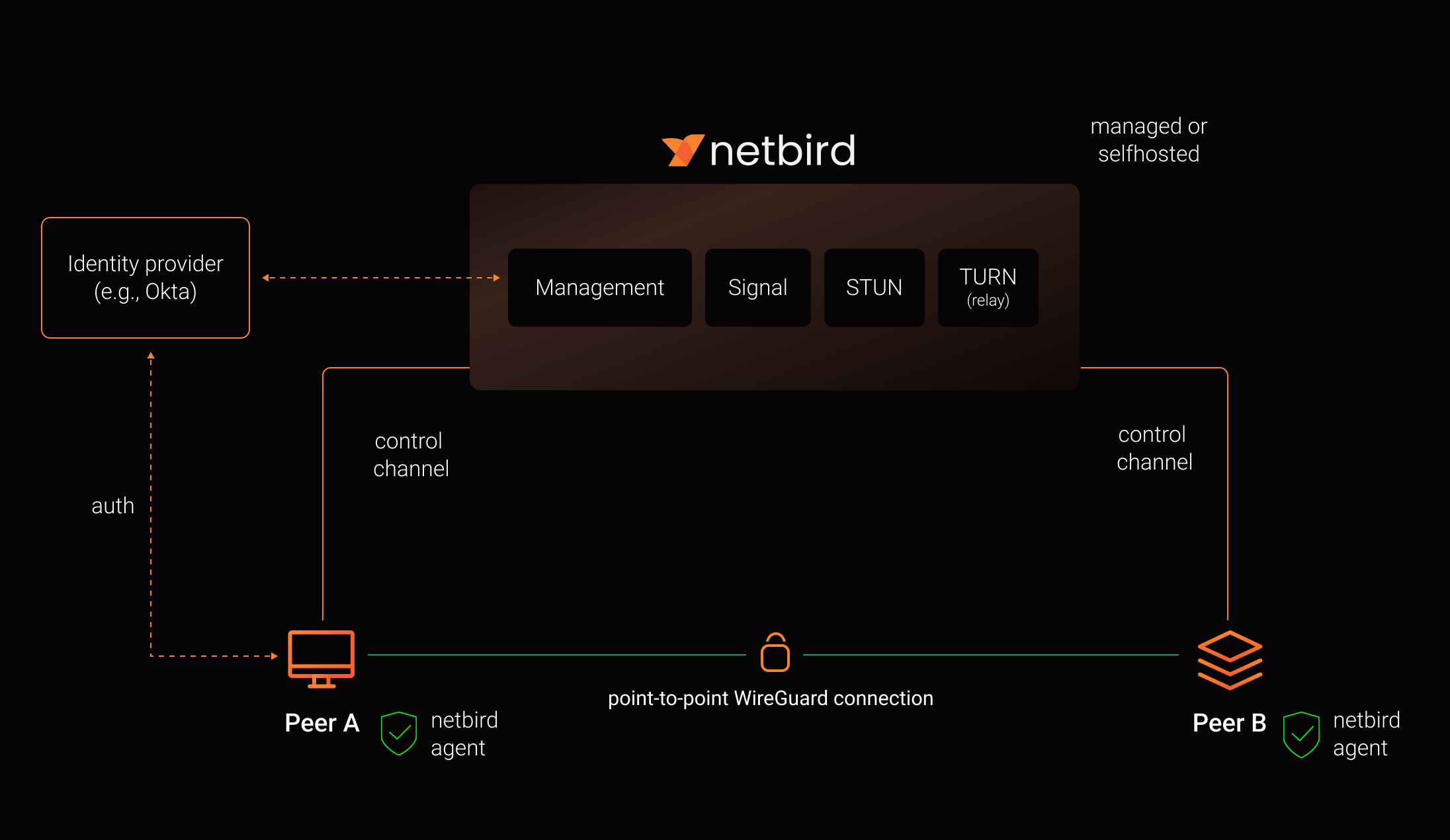
1. NetBird Client (Agent)
Runs on each machine in the network. Key responsibilities:- Manages local WireGuard interface
- Connects to Management and Signal services
- Performs ICE candidate discovery via STUN servers
- Establishes and maintains peer connections
- Applies network policies (ACLs, routes, DNS)
2. Management Service
The control plane that orchestrates the network:- Authenticates peers using SSO or setup keys
- Maintains the network map (which peers can connect to each other)
- Distributes peer configurations and network updates
- Manages access control policies and routing rules
- Stores network state and configuration
3. Signal Service
Facilitates the WebRTC signaling process:- Relays encrypted connection offer/answer messages between peers
- Exchanges ICE candidates for NAT traversal
- Does not see or store actual peer data
- Lightweight, stateless message forwarder
4. Relay Servers (TURN)
Provide fallback connectivity when direct connection fails:- Used when peers are behind strict NATs or firewalls
- Relay encrypted WireGuard traffic between peers
- Only see encrypted packets (end-to-end encryption maintained)
- NetBird uses Coturn for STUN/TURN functionality
Connection Flow
Network Map Distribution
The Management Service maintains a “network map” for each account, which defines:- Peers: All machines in the network with their public keys and metadata
- Access Policies: Which peers are allowed to connect to each other
- Routes: Network routes that should be applied
- DNS Configuration: Custom DNS zones and nameservers
- Firewall Rules: Traffic filtering rules
Security Architecture
Multiple Layers of Encryption
- WireGuard Encryption: All peer-to-peer traffic is encrypted using WireGuard’s Noise protocol
- Signaling Encryption: WebRTC offers/answers are encrypted before being sent through Signal service
- TLS: All connections to Management and Signal services use TLS
Zero-Trust Model
- Each peer has its own WireGuard key pair
- Peer authentication happens through SSO or setup keys
- Access control policies are enforced at the peer level
- No implicit trust between peers
Optional Quantum Resistance
NetBird supports Rosenpass for post-quantum secure key exchange:- Provides quantum-resistant pre-shared keys for WireGuard
- Can run in permissive mode (fallback to WireGuard-only) or strict mode
- Enhances security for long-term protection
Scalability Considerations
Horizontal Scaling
- Management and Signal services can be scaled horizontally
- Relay servers can be distributed geographically
- Network state can be stored in distributed databases
Efficient Updates
- Only affected peers receive updates when network topology changes
- Incremental updates reduce bandwidth and processing overhead
- Serial numbers prevent processing outdated configurations
Resource Efficiency
- Kernel WireGuard implementation minimizes CPU overhead
- Direct peer connections eliminate relay server load when possible
- eBPF-based packet filtering reduces kernel overhead
Platform Support
NetBird runs on:- Desktop: Linux, macOS, Windows
- Mobile: iOS, Android
- Embedded: OpenWRT, serverless environments
- Containers: Docker with host or container networking modes
Next Steps
How It Works
Detailed connection flow and NAT traversal process
Components
Deep dive into each architectural component