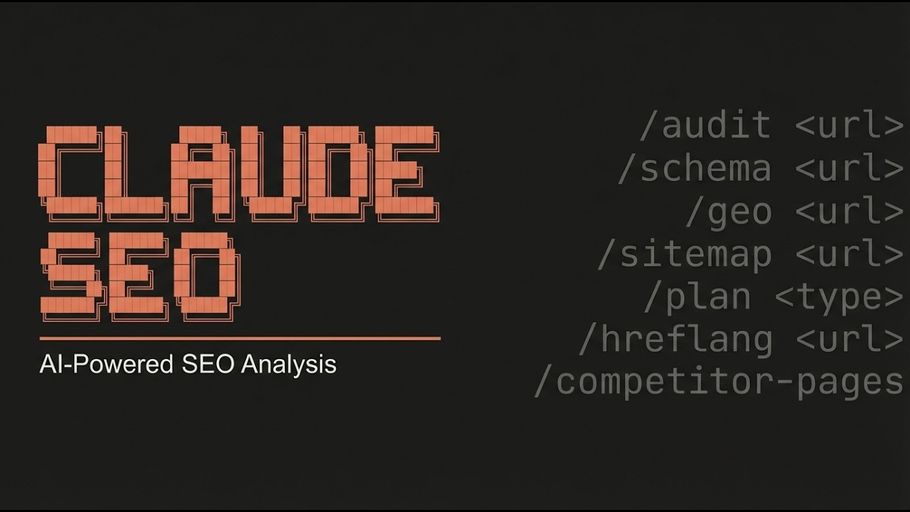
Claude SEO’s commerce and internationalization commands address two of the most technically demanding areas of modern SEO: getting product pages right for Google Shopping and AI-driven commerce surfaces, and building a correct hreflang implementation for multi-language or multi-region sites.Documentation Index
Fetch the complete documentation index at: https://mintlify.com/AgricIDaniel/claude-seo/llms.txt
Use this file to discover all available pages before exploring further.
/seo ecommerce was contributed by Matej Marjanovic (Pro Hub Challenge, v1.9.0); /seo hreflang enhancements were contributed by Chris Muller (Pro Hub Challenge, v1.9.0). Both were extended in v2 with new signal checks aligned to the January 2025 Quality Rater Guidelines and Google’s EU compliance requirements.
/seo ecommerce
Product schema validation, Google Shopping competitive intelligence, Amazon marketplace cross-reference, marketplace keyword gap analysis, and DataForSEO cost guardrails. Works fully without DataForSEO; marketplace data is additive.
/seo hreflang
Hreflang audit with eight validation checks (self-referencing, return tags, x-default, ISO codes, canonical alignment, protocol consistency), hreflang generation for HTML / HTTP header / XML sitemap, content parity audit, and cultural adaptation scoring.
/seo ecommerce <url>
/seo ecommerce covers four analysis areas: on-page product SEO, Google Shopping intelligence, Amazon marketplace cross-reference, and keyword gap analysis between organic and Shopping visibility.
Product schema validation
The skill validatesProduct schema against Google’s current requirements and scores completeness on a structured ladder:
| Schema completeness | Score |
|---|---|
All required fields (name, image, description, brand, offers) | 50/100 |
+ aggregateRating | 65/100 |
+ sku / gtin13 / mpn | 75/100 |
+ shippingDetails (ShippingDetails with rate and delivery time) | 85/100 |
+ hasMerchantReturnPolicy (MerchantReturnPolicy with type and days) | 90/100 |
| + individual reviews (3+) | 100/100 |
MemberProgram, EU energyEfficiencyClass, and ProductGroup variants — requirements that affect Google Merchant Center eligibility in the EU.
IPTC TrainedAlgorithmicMedia
For AI-generated product images, the skill checks for theDigitalSourceType: TrainedAlgorithmicMedia IPTC metadata label, now required by Google Merchant Center policy. This check surfaces through the seo-images integration layer and is reported alongside standard image optimization findings.
Marketplace intelligence
When the DataForSEO extension is installed, the skill runs Google Shopping and Amazon competitive analysis and produces a pricing intelligence report (min, max, median, P25/P75 distribution, price-to-rating correlation) and a seller landscape table (top 10 sellers by listing count, merchant rating distribution, free-shipping prevalence).Keyword gap analysis
The gap report cross-references organic keyword rankings (fromdataforseo_labs_google_ranked_keywords) against Google Shopping presence (from the Merchant API) for the same domain, producing four gap types:
| Gap type | Meaning | Recommended action |
|---|---|---|
| Organic Only | Ranks organically, no Shopping ads | Create Google Merchant Center feed for these keywords |
| Shopping Only | Shopping visible, weak organic | Create buying guides and comparison content |
| Both Present | Visible in both channels | Optimize: price consistency, enhanced schema |
| Neither | No visibility in either channel | Low priority unless high volume |
/seo hreflang <url>
/seo hreflang audits, generates, and validates hreflang implementations across all three methods: HTML <link> tags, HTTP headers (for non-HTML files), and XML sitemap (recommended for sites with many language variants or cross-domain setups).
Eight validation checks
The skill runs eight checks in sequence. A failure in the self-referencing or return-tag checks invalidates the entire hreflang signal set for the affected pages:- Self-referencing tags — Every page must include an
hreflangtag pointing to itself; the URL must match the page’s canonical exactly. - Return tags — If A→B, then B→A is mandatory. Missing return tags invalidate the signal for both pages.
- x-default tag — Required fallback for unmatched languages/regions. Only one
x-defaultper set; must also have return tags from all other language versions. - Language code validation — Must use ISO 639-1 two-letter codes. Common failures:
enginstead ofen,jpinstead ofja, barezhwithout a script qualifier (zh-Hansorzh-Hant). - Region code validation — Must use ISO 3166-1 Alpha-2. Common failures:
en-uk(should been-GB),es-LA(Latin America is not a country code). - Canonical URL alignment — Hreflang tags must only appear on canonical URLs. A page with
rel=canonicalpointing elsewhere will have its hreflang ignored. - Protocol consistency — All URLs in a set must use the same protocol. Mixed HTTP/HTTPS causes validation failures.
- Cross-domain support — Cross-domain hreflang requires return tags on both domains and both domains verified in Google Search Console. XML sitemap implementation is recommended for cross-domain setups.
Common mistakes at a glance
| Issue | Severity |
|---|---|
| Missing self-referencing tag | Critical |
| Missing return tags (A→B but no B→A) | Critical |
| Missing x-default | High |
Invalid language code (e.g., eng) | High |
Invalid region code (e.g., en-uk) | High |
| Hreflang on non-canonical URL | High |
| HTTP/HTTPS mismatch in URLs | Medium |
| Trailing slash inconsistency | Medium |
| Hreflang in both HTML and sitemap | Low |
Hreflang generation
The skill generates production-ready hreflang output for all three implementation methods. For the XML sitemap method:v2 Phase F additions
Two Phase F (v2) additions extend the hreflang skill beyond tag validation:- Machine-translation QA flag — Per the January 2025 Quality Rater Guidelines update, the skill flags pages where content appears to have been machine-translated without post-editing. This is reported as a content quality issue rather than a technical one.
- DMA consent-mode-v2 click-through diagnostic — For EU-targeted sites, the skill checks whether Google’s Consent Mode v2 is implemented correctly to maintain conversion modeling compliance under the Digital Markets Act.
Content parity audit
/seo hreflang audit checks that all declared language versions exist, have equivalent heading structure (H2/H3 count), matching SEO elements (title, meta, schema localization), appropriate word count ratios (German pages should be 25–35% longer than English; Japanese 10–25% shorter), and no stale translations. Foreign brand references on localized pages and untranslated elements are flagged as cultural adaptation issues.